
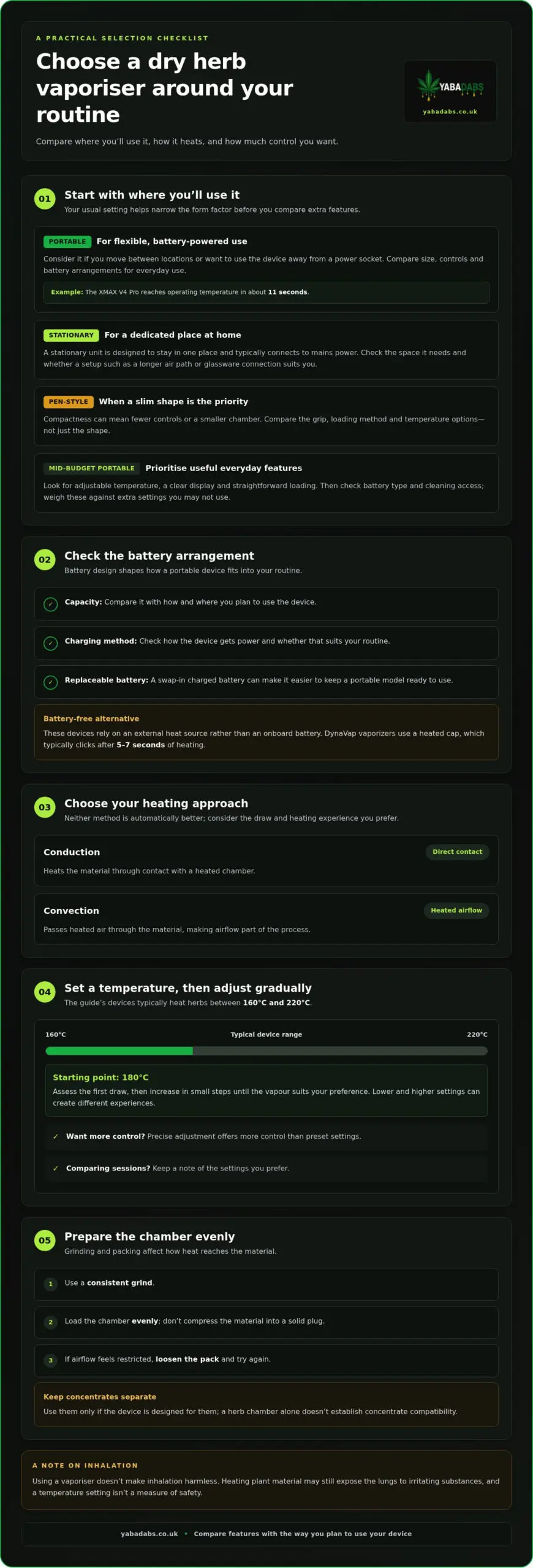
Portability isn’t the only thing that shapes the right choice. A dry herb vaporizer heats herbs below their burning point, producing vapour without combustion. Typical devices heat herbs between 160°C and 220°C.
Choosing a dry herb vaporizer means weighing where you’ll use it and how much freedom you want from a power socket. Battery capacity matters, too, and a replaceable battery can make it easier to keep a portable model ready to use.
This guide explains how vaporizers work, compares portable and stationary options, and breaks down battery features that shape everyday use. You’ll get a clearer idea of which portable dry herb vaporizer suits your routine, whether you value easy travel, fewer charging interruptions or a dependable setup at home.
Key Takeaways
- Choose a portable model for flexibility, or a stationary unit if your device will mainly stay at home.
- Compare battery capacity with how and where you plan to use your device.
- A replaceable battery can be a practical advantage when you want to swap in a charged one.
- Grinding consistency and temperature settings both shape how you prepare and use dry herb.
- Use the comparison criteria to narrow the options to the features that matter most in your routine.
Conclusion: Which Is The Best Portable UK Medical Cannabis Dry Herb Vaporizer?
There isn’t one best portable choice for every routine. Compare temperature control, heating style and preparation, then choose the features that suit how you plan to use a dry herb vaporizer. For a broader portable vaporizer comparison, consider how heating methods and everyday use affect your choice.
Temperature Settings and Customisation
Most devices in this guide heat herbs between 160°C and 220°C. A practical starting point is 180°C, followed by gradual increases until the vapour suits your preference. Lower and higher settings can create different experiences, so adjust in small steps. Precise temperature adjustment gives you more control than a model with preset settings. Keep a note of settings you prefer, so you can compare sessions consistently.
Conduction and Convection Heating
Conduction heats material through contact with a heated chamber. Convection passes heated air through the material, making airflow part of the process. Neither method is automatically better. Consider how you prefer to draw and whether direct chamber contact or air-based heating suits your routine. Device design and preparation also affect the experience.
Conduction or convection? Neither is universally better. Conduction uses direct contact with a heated chamber, while convection relies on heated airflow. Choose according to the draw and heating experience you prefer.
Are dry herb vaporizers legal to purchase in the UK? Yes, dry herb vaporizers are legal to purchase in the UK. This concerns the devices, not the legal status of any substance used in them.
What are the health risks? Using a vaporizer doesn’t make inhalation harmless. Heating plant material may still expose the lungs to irritating substances, and a temperature setting isn’t a measure of safety. Ask a qualified healthcare professional about health risks or symptoms. Our team can explain product features, but cannot provide medical advice.
Preparation and cleaning
Grinding and packing affect how heat reaches the material. Use a consistent grind, then load thechamber evenly rather than compressing it into a solid plug. If airflow feels restricted, loosen the pack and try again. Keep concentrates separate unless the device is designed for them. A herb chamber alone doesn’t establish concentrate compatibility.
| Option | Temperature approach | Heating criterion | Consider it if |
|---|---|---|---|
| Start at 180°C | Baseline setting | Assess the first draw | You’re establishing a routine |
| Increase gradually | Move towards 220°C | Compare changes in vapour | You want more control |
| Conduction | Choose a setting | Chamber contact | You prefer direct-contact heating |
| Convection | Choose a setting | Airflow through material | You prefer air-based heating |
For a product example to assess against these criteria, compare the stated details on the DaVinci IQC device page with your preferred controls and routine. The best choice is the one whose temperature range, heating style and chamber preparation suit how you intend to use it.
Portable and stationary dry herb vaporizers
The main difference is where you can use each device. A portable model runs on a battery and travels with you, while a stationary unit is designed to stay in one place and typically connects to mains power. Think about your routine first: will you use it at home, take it out, or want both options?
A portable dry herb vaporizer suits changing locations and sessions away from a socket. Size, controls and battery arrangements affect how easily it fits into daily use. For a concrete heat-up example, the XMAX V4 Pro reaches operating temperature in about 11 seconds. That quick start may suit a routine where you want less waiting before use.
Stationary models suit a regular place of use. Their larger format can accommodate a different setup, such as a longer air path or a connection to glassware. Check the space it needs and how it receives power. Portability matters less if the device stays on the same table.
Match the format to your routine
Pen-style vaporizers prioritise a slim shape, but compactness can mean fewer controls or a smaller chamber than other portable designs. Compare the grip, loading method and temperature options, not just the shape. Convection models heat material with moving air, making airflow part of the draw. A conduction chamber uses direct contact, changing how heat reaches its contents.
For a mid-budget portable dry herb vaporizer, prioritise useful controls over a long feature list. Look for adjustable temperature, a clear display and straightforward loading. Then consider the battery type and cleaning access. A model that’s easy to maintain may suit regular use better than one with extra settings you’re unlikely to use. The right balance depends on how often you travel and how much control you want.
Use this quick comparison to narrow your options:
- Portable: Choose it for flexible use and battery-powered operation.
- Stationary: Choose it for a dedicated home setup near a power socket.
- Pen-style: Choose it when a slim shape is the priority.
- Mid-budget portable: Compare core controls, battery setup and cleaning access before extras.
Before deciding, picture a typical session. If you move between rooms or travel, portability may matter most. If you stay in one place, a stationary unit may suit your setup better. Also consider where you’ll store the device and accessories between uses.
For a closer look at portable and stationary options, compare the form factor with your everyday needs and explore vaporizer options.
Battery capacity and replaceable batteries
Battery design affects how a portable device fits into your routine. Compare capacity, charging method and whether you can swap the battery between sessions.
Battery-Free Devices
Battery-free devices rely on an external heat source rather than an onboard battery. DynaVap vaporizers use a heated cap, which typically clicks after 5-7 seconds of heating. That design avoids charging a device, but it also means you need the separate heat source whenever you use it. Compare this hands-on process with an electronic model’s button controls and charging routine.
Replaceable Batteries
A replaceable battery lets you swap in a charged cell instead of waiting beside a socket. The XMAX Starry V4 uses a replaceable 2550 mAh 18650 battery. That can suit people who value carrying a spare, but you’ll need to keep compatible charged batteries available. An integrated battery is simpler to manage as one unit, but you can’t swap its cell during a session.
Battery type is as important as the word “replaceable”. Check the exact format specified for the device and use a compatible battery. The 18650 format is the relevant example for the Starry V4, not a universal fit. A spare cell only helps if it matches the device and is charged before you leave.
Battery Capacity and Charging
Capacity is measured in milliamp-hours, or mAh. The XVAPE Fog Ultra is advertised with a 2600mAh battery, while the second device in the referenced ranking has a 5940 mAh battery and fast USB-C charging. These figures help compare capacity, but they don’t tell you exactly how many sessions you’ll get. Temperature control, heating demand and session length all affect power use.
For a fair comparison, consider capacity alongside charging method and how you use the chamber. Higher settings can draw more power, and longer sessions keep the heater working for longer. A USB-C connection makes charging straightforward with a compatible cable, but fast charging is a feature to compare, not a measure of run time.
Use this simple check before choosing:
- At home: Consider whether charging between sessions fits your routine.
- While travelling: Decide whether an interchangeable battery or a charged device is more convenient.
- For longer sessions: Compare capacity, temperature settings and heating time together.
A battery’s advertised capacity is one part of the decision, not a guarantee of session length. Match it to your preferred temperature, how often you use the device and whether carrying a spare suits your day.
Product recommendations and specifications
Compare specifications that affect how a device performs, rather than relying on a score alone. Heating style, temperature control, chamber size and charging all shape the experience.
Vapour Quality and Product Scores
A product score can help shortlist devices, but it can’t tell you whether the draw, controls or cleaning routine suit you. Compare the features behind the rating. For example, the XMAX V4 Pro heats up in about 11 seconds, whilst the XMAX Starry V4 offers single-degree temperature control from 100°C to 240°C. Those details reveal more about use than a score alone.
Flavour and Vapour Production
Flavour and vapour production depend on heating, airflow, material and temperature. A hybrid heating system combines conduction and convection, but that label alone doesn’t determine the flavour or density you’ll experience. Compare the temperature range and draw design, then consider how you’ll prepare the chamber. Keep concentrates separate unless the device is designed for them.
Temperature also changes the character of a session. The general range for dry herbs is 160°C to 220°C. Starting at 180°C and adjusting in stages gives you a practical way to compare flavour and vapour output. A precise control can make those adjustments easier; preset steps offer a simpler routine.
Trending Vaporizer Products
Rather than treating “trending” as a quality measure, compare the features attracting attention. The XMAX Starry V4 pairs a replaceable 2550 mAh 18650 battery with single-degree temperature control. The DynaVap M7 XL has an adjustable bowl for 0.1 g loads or 0.05 g microdoses. These specifications suit different priorities, not one universal preference.
Use product names as starting points for comparison, not automatic recommendations. An XMAX V4 Pro’s approximate 11-second heat-up may appeal if a quick start matters. The Starry V4’s broad temperature span gives more adjustment options. Meanwhile, DynaVap’s M7 XL uses a different, manually heated format. Check the design against your preferred routine before weighing individual features.
Price and delivery are separate buying criteria. Prices can change, so don’t assume a named device has one fixed UK price. Compare the displayed cost, delivery charge and stated terms before purchase. Don’t judge value by device price alone: included accessories, battery arrangements and useful controls also matter.
For a clear shortlist, compare each model against the same four points:
- Heating: Decide whether conduction, convection or hybrid heating suits your preferences.
- Control: Compare exact temperature adjustment with preset settings.
- Use: Consider heat-up time, chamber size and cleaning access.
- Ownership: Check battery type, included accessories and delivery terms.
That approach keeps specifications practical. Choose the features you’ll use regularly, then compare models such as the XMAX V4 Pro, Starry V4 and DynaVap M7 XL on equal terms.
Dry herb vaporizer selection
Choose a model around your routine, not its feature list. When buying a dry herb vaporizer, compare portability, heating controls, battery setup and cleaning access. These choices affect how easily the device fits into everyday use.
What should you look for when buying one? Start with where you’ll use it, then compare temperature control, chamber size, battery arrangement and mouthpiece design. Check whether its shape fits a pocket or suits a dedicated home spot, and whether its controls are clear to operate.
Make portability practical. A slim shape may fit a pocket more easily, while a larger device can offer a different chamber or grip. Consider the whole routine: carrying the device, loading it, using the mouthpiece and storing it afterwards. A travel-friendly design is less convenient if its charging method doesn’t suit your day.
Look closely at cleaning access before you choose. Check how the mouthpiece and chamber come apart, and whether you can reach the screen without awkward tools. A grinder can help prepare material consistently, but the chamber still needs to be loaded so air can pass through. For example, compare a removable mouthpiece with a design that requires more careful access.
Compare controls and maintenance
Temperature controls should match your preferred level of involvement. A device with precise adjustment gives you room to change settings in small steps; preset options keep operation simpler. The general heating range for dry herbs is 160°C to 220°C, and starting at 180°C gives you a baseline for exploring adjustments. Treat the range as a practical comparison point, not a promise of identical vapour from every model.
Battery choices influence travelling and charging habits. The XMAX Starry V4 has a replaceable 2550 mAh 18650 battery, whilst the XVAPE Fog Ultra is advertised with a 2600mAh battery. Compare whether swapping a cell or charging the device suits your routine. Capacity alone won’t establish how many sessions you’ll get, since temperature and session length also affect power use.
Use this short checklist to compare models on equal terms:
- Fit: Decide whether pocket-sized portability or a home setup matters more.
- Controls: Compare precise temperature adjustment with preset settings.
- Upkeep: Look for straightforward access to the chamber, screen and mouthpiece.
- Power: Check charging method, capacity and whether the battery is replaceable.
- Preparation: Consider whether your grinder and loading routine suit the chamber.
Compare those points against your actual routine, rather than choosing by a single specification. Explore vaporizer options and narrow your shortlist by portability, controls and battery design.
Compare dry herb vaporizer formats
Compare device formats using our portable vaporizer comparison, then check current listings in the yabaDABS shop. Follow each model’s instructions for heating and battery care. For help choosing a format, ask our Lisburn team.
Make your next choice with confidence
Before choosing a dry herb vaporizer, decide which trade-off you’re happiest to make. Is carrying it easily more important than having a dedicated home setup? Would you rather keep charging simple or have the option of a manually heated device? A short list of priorities makes product details easier to compare and helps you focus on features that suit your routine.
If you want to explore different formats, yabaDABS offers DynaVap vaporizers and Hamilton Devices vaporizers, alongside a range of other premium options. Consider which direction best matches your priorities, then browse with a clear idea of the experience you want. There’s no need to settle on a model just because one feature sounds impressive; your everyday habits are a useful guide.
Ready to take the next step? Contact yabaDABS for help and explore the options at your own pace. A considered choice starts with what works for you.
Frequently Asked Questions
What is a vaporizer?
A vaporizer is a device that heats material to create vapour for inhalation. Unlike a device that burns material, its heating process is designed to avoid combustion. Vaporizers vary in what they’re designed to use, how they heat and whether they need a battery. Before using one, read its instructions and confirm the material and accessories are suitable for that specific model.
Portable vs Desktop: Which Do You Actually Need?
Choose portable if you want a device you can take between locations; choose desktop if it will mainly stay in one place. For example, someone who travels regularly may value a compact, battery-powered option, while a home user may prefer a mains-powered setup. Think about where you’ll use it, where you can charge or plug it in, and whether carrying extra accessories would be inconvenient.
What is a dry herb vaporizer and how does it work?
A dry herb vaporizer heats plant material in a chamber so vapour forms without burning it. A heater warms the material, and airflow carries vapour through the mouthpiece as you draw. Models differ in heating method and material compatibility, so don’t assume one device suits every substance. Compatibility varies by model. Check the product description and manufacturer instructions before choosing materials or accessories.
What are the best dry herb vaporizers available in the UK in 2026?
There isn’t one best model for every user in the UK in 2026. Compare the format, controls and intended materials of options such as DynaVap, XMAX, XVAPE and Focus V devices. Consider each product’s features against your own routine rather than relying on a ranking. Our reference to a product, service, or process does not imply a recommendation or approval. It also does not imply affiliation or sponsorship by yabaDABS.
How much do dry herb vaporizers cost in the UK?
Prices in the UK vary by device design, controls, battery setup and included accessories. A basic portable model and a more feature-rich device won’t necessarily have the same price. Compare the full product listing, including what comes in the box and any delivery charge, rather than judging by the device alone. Prices can change and don’t determine whether a model suits you.
How do portable and desktop dry herb vaporizers compare?
Portable models prioritise mobility and usually rely on a battery; desktop models are designed for a fixed setup and commonly use mains power. That difference shapes where you can use them and how you prepare. For instance, someone with limited storage may favour a compact device, while a regular home setup can accommodate a larger unit and its accessories.
How do you use and clean a dry herb vaporizer?
Start by reading the model’s instructions, then load the chamber as directed and select a suitable setting. After each session, switch the device off, let it cool and empty the chamber. Remove loose residue with the recommended cleaning tool, then clean the mouthpiece and screen using the method specified for that model. Keep liquids away from electronic parts and reassemble only when components are dry.
What temperature should you use in a dry herb vaporizer?
A useful starting point is 180°C. Dry herb vaporizers commonly operate between 160°C and 220°C, so increase the setting gradually if you want to compare the vapour at different temperatures. Make small adjustments rather than changing several settings at once. The material, device design and airflow can affect the result, so follow the manufacturer’s temperature guidance for your particular model.