
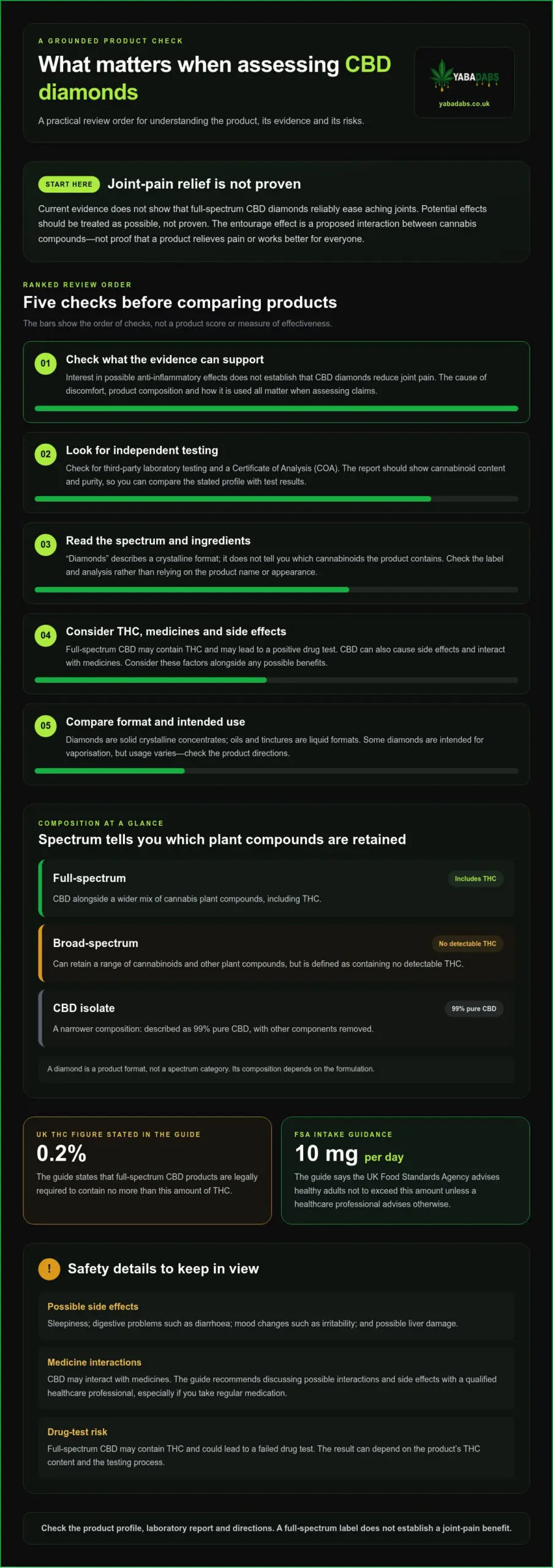
CBD isn’t an established treatment for joint pain. Current evidence doesn’t show that full-spectrum CBD diamonds reliably ease aching joints, so any potential benefits should be viewed as possible, not proven. Full-spectrum products contain CBD alongside other cannabis plant compounds, including THC.
It’s understandable to look for options that may help you feel more comfortable. But a CBD product’s composition matters: diamonds differ from oils and isolates in both form and the range of plant compounds they contain. This guide explains those differences and what current evidence can, and can’t, tell us about joint pain and other potential effects.
You’ll also learn how the entourage effect is described, what to consider about CBD and medicines, and why claims deserve careful scrutiny. The aim is to give you clear, grounded information to help you understand a product before deciding whether it suits your needs.
Key Takeaways
- Learn what full-spectrum CBD contains and how its mix of plant compounds differs from CBD isolate and broad-spectrum products.
- Understand the entourage effect as a proposed interaction between cannabis compounds, not proof of a particular health benefit.
- See how the endocannabinoid system relates to the body’s internal balance and why that does not establish CBD as a joint-pain treatment.
- Explore the potential benefits and safety considerations of CBD, including possible interactions with medicines.
- Use the evidence to assess claims about CBD and joint pain with a clear distinction between potential effects and proven treatment.
The entourage effect
The entourage effect is a proposed interaction between CBD and other cannabis compounds. It may inform discussions of full-spectrum products, but it doesn’t prove pain relief.
How the entourage effect works
The idea is that cannabinoids and other plant compounds may work together, producing an effect different from CBD alone. Full-spectrum CBD contains CBD alongside other cannabis compounds, including THC. That combination is why the entourage effect comes up when comparing product types. It remains a proposed explanation, not evidence that a particular blend treats joint pain or works better for everyone.
CBD diamonds are concentrated crystalline products. Full-spectrum diamonds may retain or be combined with other plant compounds, depending on how they’re made. Some products are intended for vaporisation, but the product label should state how they’re meant to be used. To assess quality, look for independent laboratory testing and a Certificate of Analysis showing cannabinoid content and purity.
There’s no single UK price for CBD diamonds. Cost can depend on the amount, concentration and formulation. Assess quality by checking laboratory results and clear ingredient information, not appearance alone.
Potential anti-inflammatory effects
Anti-inflammatory properties describe a possible effect on processes involved in inflammation. This is one reason CBD attracts interest from people seeking relief from sore joints. However, interest in a biological effect doesn’t prove that CBD diamonds reduce joint pain. The product’s composition, how it’s used and the cause of discomfort all matter when assessing claims.
CBD products can cause side effects, including sleepiness, digestive problems such as diarrhoea, mood changes such as irritability, and possible liver damage. CBD may also interact with medicines. The UK Food Standards Agency advises healthy adults to limit CBD intake to no more than 10 mg per day unless a healthcare professional advises otherwise. Discuss potential interactions and side effects with a qualified healthcare professional, especially if you take regular medication.
THC limits and psychoactive effects
A 0.2% THC figure is not a general legal limit for finished CBD products. UK rules depend on the product and any controlled cannabinoids it contains. Check the Home Office guidance on CBD and controlled cannabinoids. A laboratory result alone does not establish that a product is lawful.
Could CBD diamonds cause a positive drug test? Yes. Full-spectrum CBD may contain THC, and use may lead to a failed drug test. The result can depend on factors such as the product’s THC content and the testing process, so a full-spectrum label doesn’t remove that risk.
How are full-spectrum CBD diamonds made and used? They’re concentrated crystalline CBD products made from cannabis extract, with other plant compounds retained or included in the formulation. Some are intended for vaporisation. Follow the product’s directions, and don’t assume every diamond product is used in the same way.
For a different CBD format, topical products are applied to the skin rather than inhaled. A CBD topical cream illustrates that distinction, though topical application and diamonds are not interchangeable routes.
How full-spectrum CBD differs from isolate and broad-spectrum CBD
CBD products mainly differ in which cannabis plant compounds they retain. This distinction helps you compare full-spectrum CBD, broad-spectrum CBD and isolate without assuming they have identical effects.
Full-spectrum CBD is generally described as retaining a wider mix of cannabis plant compounds. Broad-spectrum CBD can retain a range of cannabinoids and other plant compounds, but is defined as containing no detectable THC. CBD isolate takes a narrower approach: it is described as 99% pure CBD, with other components removed.
These differences matter when comparing ingredients, rather than relying on product names alone. A full-spectrum label indicates a broader mix of compounds, including THC. Broad-spectrum products retain a range of plant compounds without detectable THC, while isolate focuses on CBD itself. The label and product analysis help show which profile you’re choosing.
CBD diamonds differ from CBD oil in form. Diamonds are solid crystalline concentrates, while oils and tinctures are liquid formats. A diamond product’s spectrum depends on its formulation, so “diamonds” alone doesn’t tell you whether it’s full-spectrum, broad-spectrum or isolate. Check the stated cannabinoid profile before comparing it with oil or another concentrate.
Compare labels and batch reports
How do CBD diamonds compare with CBD oil, isolate and other concentrates? Diamonds are crystalline concentrates, oils are liquid products, and isolate describes a CBD composition rather than a format. Compare the ingredients and cannabinoid profile, because concentrates can differ in both form and spectrum.
Tinctures provide a useful contrast: CBD oils and tinctures allow precise dosing, while a solid diamond is a different format. That doesn’t mean one type is automatically better. Start your comparison with the intended use, the labelled CBD amount and whether the product contains other cannabinoids.
To assess quality, look for third-party testing and a Certificate of Analysis. The report should identify cannabinoid content and purity, allowing you to compare the stated profile with the test results. A full-spectrum label paired with a report showing the cannabinoid profile, for example, tells you more than a product name alone.
Use a simple comparison before deciding: identify the format, read the spectrum claim, then review the laboratory report. If CBD could affect a medicine you take, consult a qualified healthcare professional about interactions. This applies whether you’re considering full-spectrum CBD, broad-spectrum CBD, isolate or a tincture.
Endocannabinoid system and homeostasis
The endocannabinoid system, often shortened to ECS, helps regulate processes involved in the body’s internal balance, or homeostasis. Researchers discovered the system in the 1990s. It includes endocannabinoids made by the body, receptors that receive their signals, and enzymes that break them down. This framework explains why CBD attracts interest, but it doesn’t establish CBD diamonds as a treatment for pain or disease.
Think of the ECS as a signalling network, not a single switch. Endocannabinoids act as messengers, binding to receptors in different parts of the body. CB1 and CB2 are two receptor types commonly discussed in cannabis science. Their presence doesn’t mean every cannabinoid acts on them in the same way. The body’s own signalling compounds and the location of a receptor both shape the response.
CBD and tetrahydrocannabinol, or THC, are cannabinoids derived from plants. Unlike endocannabinoids, they aren’t made by the body. THC can interact with cannabinoid receptors and cause intoxicating effects. CBD has a different profile and doesn’t produce the same typical high. These distinctions matter when assessing wellness claims: a shared connection to the ECS doesn’t make CBD and THC interchangeable.
Separate mechanisms from evidence
Full-spectrum products combine CBD with other cannabis plant compounds, such as THC and terpenes. The proposed entourage effect suggests these compounds can interact, but it doesn’t show that a product restores homeostasis or treats a condition. For example, terpenes listed on a label describe the product’s composition, not proven relief. The cannabinoid mix is one part of understanding what a product contains.
Homeostasis describes the body’s ongoing adjustment of internal conditions. It isn’t a fixed state that a supplement can simply switch on. Sleep, movement, stress and illness can all affect how someone feels, while the ECS is only one part of the body’s complex regulation. So, a link between CBD and ECS activity doesn’t establish a direct benefit for joint pain, sleep or general wellness.
To assess claims, separate three things: what the product contains, how a proposed mechanism works, and what an outcome study actually measures. A laboratory explanation about receptors isn’t the same as evidence that people experience pain relief. Likewise, an animal finding doesn’t automatically establish a result in humans. Keeping these distinctions clear makes claims about CBD and disease easier to assess.
The ECS helps explain why cannabinoids are studied, not what an individual product will do. When considering CBD, focus on its stated composition and the specific benefit being claimed. A claim about receptor activity, for instance, can’t by itself show that a full-spectrum product improves mobility or supports a diagnosed condition.
Full spectrum CBD definition and composition
What are full-spectrum CBD diamonds? They’re crystalline CBD concentrates described as full-spectrum when they retain CBD alongside other cannabis plant compounds, including THC. “Diamonds” describes their concentrated, crystal-like form, while “full-spectrum” describes the range of compounds in the formulation. The label alone doesn’t specify every ingredient or explain how the product should be used.
Cannabis plants contain more than 500 chemical compounds, including more than 100 cannabinoids. CBD, or cannabidiol, is one cannabinoid; THC, or tetrahydrocannabinol, is another. Full-spectrum extracts can also contain terpenes and other plant compounds. The precise composition depends on the extract and final formulation, so the product’s ingredient information and laboratory analysis help identify what it contains.
CBD is derived from cannabis, including hemp plants. “Hemp” describes a type of cannabis plant, not a guarantee that an extract contains no THC. A full-spectrum label indicates that THC and other plant compounds may remain. This matters when comparing full-spectrum diamonds with CBD isolate, which removes other components, or broad-spectrum CBD, defined as having no detectable THC.
Read the final product information
Diamonds are a physical form, not a separate cannabinoid category. A crystal-like concentrate may be marketed as full-spectrum if its formulation contains CBD alongside other cannabis compounds. Check the label for the stated spectrum and intended use, then compare those details with a Certificate of Analysis. The report can help you assess cannabinoid content and purity instead of relying on the word “diamond”.
A 0.2% THC figure is not a general legal limit for finished CBD products. UK rules depend on the product and any controlled cannabinoids it contains. Check the Home Office guidance on CBD and controlled cannabinoids. A laboratory result alone does not establish that a product is lawful.
The United States has a separate legal framework. The 2018 US Farm Bill removed hemp from the legal definition of marijuana in the Controlled Substances Act. That US change does not set the rules for products sold in the UK. A US legal description therefore cannot replace checking the UK-specific information attached to a product.
Composition also explains why full-spectrum products are discussed in relation to the endocannabinoid system. CBD and THC are plant-derived cannabinoids, while terpenes are another group of plant compounds. Their presence describes the extract, not a proven health outcome. A proposed interaction between compounds doesn’t establish that a particular diamond treats pain, disease or another condition.
To assess full-spectrum CBD diamonds, separate three details: the crystal concentrate’s format, the cannabinoids and other compounds it contains, and its stated THC content. Then compare the label with laboratory results. This gives you a clearer picture of what “full-spectrum” means for that product, without treating a general definition as a guarantee of effects.
Full-spectrum CBD
Full-spectrum CBD is a cannabis extract containing CBD alongside THC and other plant compounds. That broader profile is the key distinction, not proof of stronger relief. Potential full spectrum CBD diamonds benefits depend on what the product contains and which outcome you’re considering. A label describing a spectrum can’t establish that a product eases joint pain.
Studies explore different CBD effects, but their findings don’t all answer the same question. A study of 26 healthy men found that 600 milligrams of CBD daily for 7 days led to short-term blood-pressure reductions compared with placebo. The effect was lost after 7 days. That result concerns blood pressure, not joint pain, and shouldn’t be treated as evidence of lasting relief.
Evidence about one CBD formulation does not establish a benefit for CBD diamonds. NICE guidance on chronic pain does not recommend offering CBD for chronic pain outside a clinical trial. Do not use a retail CBD product as a substitute for prescribed treatment.
Check evidence and possible risks
For joint discomfort, ask whether research measured pain or mobility in people with similar symptoms. A laboratory finding about anti-inflammatory properties isn’t the same as a human trial showing pain relief. Likewise, evidence about CBD alone may not describe a full-spectrum extract containing THC and other compounds. Keep both the claimed outcome and the formulation tested in view.
CBD can cause side effects and interact with medicines. The Food Standards Agency’s 10 mg daily precautionary limit concerns CBD consumed in food and supplements by healthy adults; it is not an inhalation dose. Potential concerns include sleepiness, digestive problems, mood changes and liver damage. If you take regular medicines, discuss possible interactions and side effects with a qualified healthcare professional before using CBD.
A 0.2% THC figure is not a general legal limit for finished CBD products. UK rules depend on the product and any controlled cannabinoids it contains. Check the Home Office guidance on CBD and controlled cannabinoids. A laboratory result alone does not establish that a product is lawful.
Compare types of CBD by looking at the extract, cannabinoid profile, intended use and evidence for the specific outcome you care about. Don’t use a blood-pressure or sleep result as a substitute for joint-pain evidence. The clearest takeaway is that full-spectrum CBD has a wider range of plant compounds, while claims of pain relief still need relevant human evidence. Explore the available product range to compare CBD formats and product information.
Compare CBD formats and labels
Read our CBD label and product guide before comparing formats. A cream, oral product and inhaled concentrate have different intended uses. A laboratory report describes a batch; it does not prove a medical benefit.
For questions about symptoms, medicines or suitability, speak to a qualified healthcare professional.
Choose your next step with confidence
Base your next step on what you want to understand or use, rather than a broad promise on a label. If you’re considering the potential benefits of full-spectrum CBD diamonds for joint pain, keep the distinction clear: current evidence does not establish them as a treatment. Discuss questions about CBD, medication or symptoms with a qualified healthcare professional.
For equipment, yabaDABS offers Hamilton Devices vaporizers and alternative premium devices. These are product options, not medical advice. Consider how the intended product format and device fit together, and follow the product’s usage information.
If you’d like to explore the range or raise a question about CBD products, contact yabaDABS with your CBD questions. Take the time you need to make an informed choice that feels right for you.
Frequently Asked Questions
What are the side effects of CBD?
CBD can cause sleepiness, diarrhoea, irritability and other digestive or mood changes. It may also affect the liver or interact with medicines. The Food Standards Agency’s 10 mg daily precautionary limit concerns CBD consumed in food and supplements by healthy adults; it is not an inhalation dose. If you take prescribed medicines, discuss possible interactions before trying a CBD product, and seek medical advice if you develop concerning symptoms.
What benefits are claimed for full-spectrum CBD diamonds, and what evidence supports them?
Claims often focus on pain relief, anti-inflammatory properties and possible effects from several plant compounds working together. These proposed benefits don’t establish that diamonds relieve joint pain. Evidence from studies of other CBD products or outcomes can’t automatically be applied to diamonds. Look for research that tests the same product type and measures the claimed benefit, such as pain or mobility, rather than relying on a general claim about CBD.
What cannabinoids and terpenes do full-spectrum CBD diamonds contain?
CBD and THC are the main cannabinoids generally discussed in full-spectrum products, but the precise profile varies by formulation. Some extracts also retain minor cannabinoids and terpenes, which are aromatic plant compounds. A product name alone can’t identify every compound present. For a specific diamond product, review its ingredient information and laboratory analysis to see which cannabinoids and terpenes were detected in that batch.
What is the typical CBD concentration and serving size of CBD diamonds?
There isn’t one standard concentration or serving size for all CBD diamonds. A product listing may state a concentration, but that figure doesn’t tell you how much CBD is in the amount used. Check the label and laboratory report for CBD content and serving guidance. The FSA’s 10 mg daily precautionary limit concerns food and supplements consumed by healthy adults. It does not define a safe amount to inhale.
What are the possible side effects and risks of CBD diamonds?
CBD diamonds may have the same CBD-related concerns as other formats, including sleepiness, digestive upset, mood changes, liver effects and medicine interactions. Full-spectrum products also contain THC, which can cause intoxicating effects and may contribute to a positive drug test. With concentrated formats, follow the product’s stated use and don’t assume a small-looking amount contains little CBD.
Are full-spectrum CBD diamonds legal to buy in the UK, and what THC limits apply?
A 0.2% THC figure is not a general legal limit for finished CBD products. UK rules depend on the product and any controlled cannabinoids it contains. Check the Home Office guidance on CBD and controlled cannabinoids. A laboratory result alone does not establish that a product is lawful.