Vaping CBD in the UK raises different questions from using oral oils or edibles. Inhaling CBD avoids digestion, but this does not establish a medical benefit or a safe inhaled dose. Onset and effects vary by product and person. Oral CBD oils and topical creams must not be put in a vape.
If you’re considering CBD while quitting smoking, separate the familiar vaping ritual from the question of whether CBD helps people stop smoking. Inhaled CBD passes from the lungs into the bloodstream, bypassing digestion. This guide explains how vape devices heat CBD e-liquid, how vaping compares with oils, edibles and smoking, and what to consider when choosing a method. You’ll also find practical guidance on ingredients, devices and safety, so you can weigh the faster onset against the uncertainties and decide what matters most to you.
Key Takeaways
- Vaping may deliver CBD faster than oils or edibles, while each method differs in how it’s taken and how long its effects may last.
- Keep CBD oil for under-the-tongue use or food; vape e-liquid is made to be heated and inhaled.
- The Food Standards Agency’s October 2023 advice recommends healthy adults limit CBD from food to 10mg per day, about 4-5 drops of 5% CBD oil.
- Public Health of England is cited for the comparison that vaping is 95% less harmful than smoking; this doesn’t establish CBD vaping as a way to quit smoking.
- Learn how device type and e-liquid ingredients affect the experience, and weigh the potential benefits against the uncertainties around inhaling CBD.
Is vaping CBD better than taking CBD oil or edibles?
Vaping may suit someone looking for a faster onset, while oils and edibles avoid inhaling CBD. The right fit depends on how you prefer to take it and what you value.
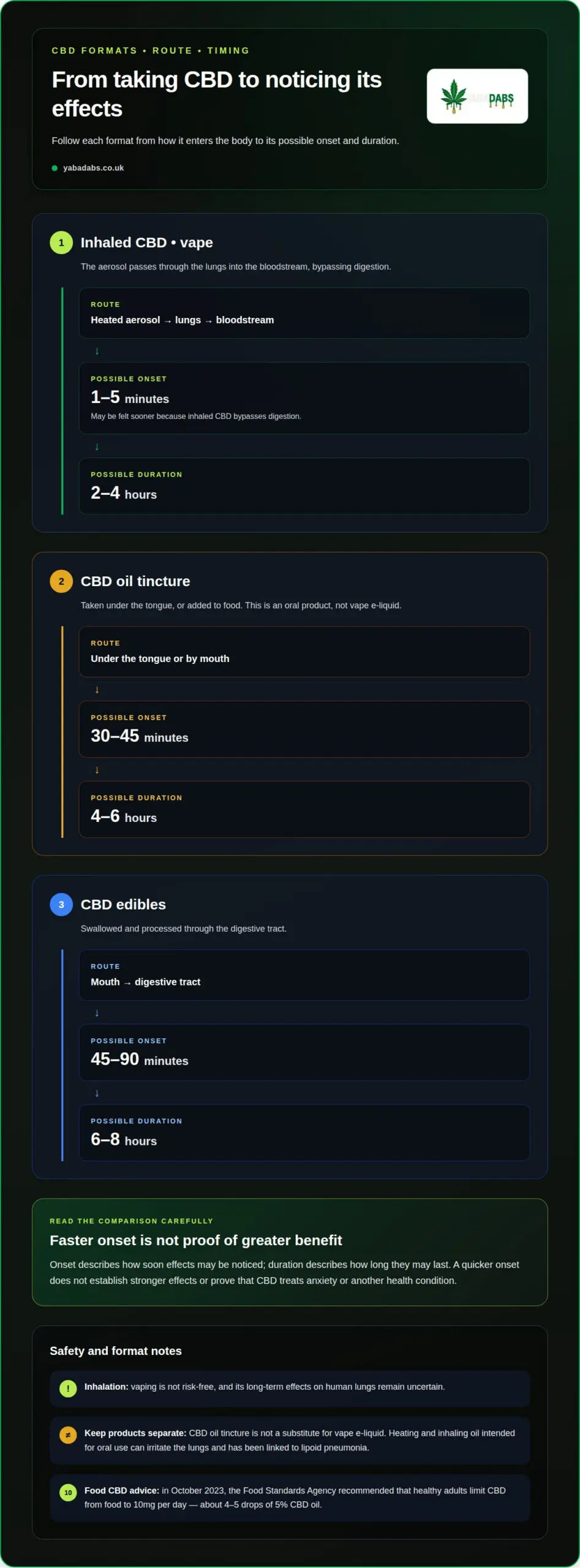
Inhalation and oral use follow different routes through the body. Timing varies with the formulation, amount and person, so a fixed number of minutes is not a reliable promise. A quicker onset does not prove stronger effects or relief from anxiety or another condition.
Speed of effects across CBD formats
Onset describes how soon you may notice effects after vaping, taking oil or eating an edible. Vaping may act sooner because inhaled CBD bypasses digestion. Oil taken under the tongue follows a different route from an edible, which passes through the digestive tract. A faster onset can make timing easier to notice, but it doesn’t establish stronger effects or prove that CBD treats anxiety.
Safety of inhaling CBD over time
Inhaling CBD means drawing heated aerosol into the lungs, exposing them directly to the product’s ingredients. Vaping isn’t risk-free, and the long-term effects on human lungs remain uncertain. Laboratory findings involving one commercial CBD vape product, mice and human cells don’t establish the effects of every formulation. Descriptions such as “natural” or “additive-free” don’t prove that a vape is safe to inhale.
Possible effects on alertness and focus
CBD can cause drowsiness and may interact with medicines. Feeling an effect quickly does not mean it improves concentration or is safe before driving. Speak to a pharmacist or clinician about medicine interactions, and do not drive if you feel sleepy or impaired.
Other possible side effects include diarrhoea, appetite changes and mood changes. CBD can also interact with medication, and potential effects include liver damage. Anyone with a serious medical condition or using prescription medication should consult a physician before use. The Food Standards Agency issued updated precautionary advice in October 2023, recommending healthy adults limit CBD from food to 10mg per day, about 4-5 drops of 5% CBD oil.
Duration differs too: vaping effects may last 2-4 hours, compared with 4-6 hours for oil tinctures and 6-8 hours for edibles. A dedicated vaporiser is a separate device format from oral CBD; the Storz & Bickel vaporiser page gives an example of that hardware category. Weigh the quicker onset against inhalation concerns and the longer potential duration of oral options.
Differences between CBD vape e-liquid and CBD oil tinctures
The key difference is intended use: CBD vape liquid is heated and inhaled, while CBD oil tinctures are taken under the tongue or added to food. A tincture may contain coconut or hemp seed carrier oil. It’s a different product, not a substitute for e-liquid in a vape. Heating and inhaling oil intended for oral use can irritate the lungs and has been linked to lipoid pneumonia. Keep the formats separate, even if both labels describe CBD wellness products.
CBD vape liquids typically contain CBD, vegetable glycerine, propylene glycol and flavourings. These ingredients help carry CBD and create an aerosol when heated. Formulations vary: some use terpenes to thin hemp extract, while certain CO₂ extraction methods can produce an extract thin enough for a cartridge without extra thinning agents. Read each product’s ingredient information. Flavour describes taste, not safety, and terms such as “natural” or “pure” don’t establish that a product is safe to inhale.
Check carrier ingredients
Carrier agents can behave differently when heated. In a study, propylene glycol, vegetable glycerine, medium-chain triglyceride oil and polyethylene glycol 400 were heated to 230°C. Polyethylene glycol 400 produced more acetaldehyde and formaldehyde byproducts than the other agents. Propylene glycol produced significantly more formaldehyde byproduct than vegetable glycerine, medium-chain triglyceride and polyethylene glycol 400. These findings concern heated ingredients under study conditions. They don’t establish that every CBD vape has the same composition or produces identical exposure.
Medium-chain triglyceride oil deserves particular care as an ingredient. Heating it can produce hydrocarbons and reactive aldehydes that may damage lungs, and it has been found in some EVALI cases. A study in Thorax compared aerosols from one commercial CBD vape product and one nicotine product using mice and human cells grown in a laboratory. The CBD liquid contained MCT; the nicotine liquid contained propylene glycol and vegetable glycerine. Their flavourings also differed, so the comparison can’t show that every CBD vape is more harmful than every nicotine vape.
CBD distillate is refined through heating and cooling, separating compounds and removing impurities. Distillate vape oil is often clearer and thinner than hemp-extract-infused liquid, with milder flavour because it contains fewer compounds such as naturally occurring terpenes. A prescribed CBD vape cartridge used with a 510 battery is distinct from consumer CBD vape products. So is prescribed cannabis flower used in a dry-herb vaporiser. Evidence about one format shouldn’t automatically be applied to another. Choose according to the product’s intended use, ingredients and formulation, not simply the word “CBD” on the label.
Vaping compared with smoking
Vaping produces an inhaled aerosol, while smoking burns material and creates smoke. That distinction matters, but comparisons between nicotine vaping and CBD products need care.
CBD vaping compared with other formats
This comparison looks at how CBD enters the body through inhalation, swallowing or topical application. The route matters because each format works differently, not because one automatically provides better relief. Edibles and capsules are swallowed; tinctures are taken under the tongue or added to food. Topicals are applied to the skin, while CBD vape liquid is inhaled into the lungs.
Vaping may produce effects within minutes, whereas swallowed formats must pass through digestion. An oil tincture taken under the tongue is different from vape liquid formulated for heating. A topical cream is another distinct option, applied to the skin rather than swallowed or inhaled. CBD isolate describes a type of CBD ingredient, not a delivery method. Compare the route and intended use before choosing.
Onset compared with oils and capsules
Onset is the time between taking CBD and noticing effects. Inhalation may act sooner because CBD is absorbed through the lungs into the bloodstream, bypassing digestion. Oils and capsules follow oral routes, so their timing differs. This distinction can help you consider how a method might fit your routine, but faster onset doesn’t show that CBD treats anxiety or another condition.
Vaping also differs from smoking cannabis in how the material is heated. Combustion burns plant material; vaporising heats material to produce vapour instead. Consumer CBD vape liquid isn’t the same as prescribed cannabis flower used in a dry-herb vaporiser. Evidence about one format shouldn’t automatically be applied to another. A laboratory comparison of one commercial CBD vape and one nicotine product also can’t show that every CBD vape is more harmful than every nicotine vape.
Evidence about nicotine e-cigarettes should not be presented as proof that CBD vaping is safe. CBD formulations and routes of use differ. Check the NHS information on CBD and cannabis products for evidence limits and possible medicine interactions.
Choose a method based on the route you’re comfortable with and the product’s intended use. For example, someone avoiding inhalation may prefer an oral format, while someone choosing a topical applies it to the skin. CBD vaping involves inhalation, so weigh its potential effects alongside the uncertainty around regular lung exposure. No single format suits every preference.
CBD e-liquid ingredients and how vaping devices work
CBD e-liquid is made for a compatible vaping device, which heats the liquid into an inhalable aerosol. There’s no single UK price for CBD vaping. Cost depends on the formulation, CBD amount and pack size.
Choosing e-liquids and devices
Choose e-liquid by matching its ingredients and strength to a device designed for that liquid. The device heats what you inhale, so compatibility and clear labelling matter. CBD e-liquid typically contains CBD, vegetable glycerine, propylene glycol and flavourings. Some formulations use terpenes to thin the extract. Base your choice on listed ingredients and intended use, not flavour alone.
Strength labels vary, with available examples including 3 mg, 6 mg, 10 mg, 12 mg, 18 mg and 20 mg. These figures identify listed strengths; they don’t explain how much CBD you’ll absorb from each puff. Read the product label carefully. A lower-powered mouth-to-lung device is often paired with e-liquid around an 80:20 PG-to-VG ratio, which describes the balance of propylene glycol and vegetable glycerine.
Using CBD e-liquids
Using CBD e-liquid means filling a compatible device and inhaling the aerosol it produces. Follow the device maker’s instructions, as filling and operation vary between models. If you’re new to CBD vaping, begin with one or two puffs, then pause and notice how you feel. Starting low and increasing gradually can help you avoid taking more before you understand your response.
Don’t put oral CBD oil into a vape. Tinctures may contain carrier oils such as coconut or hemp seed oil, while vape liquid is formulated for heating. Inhaling heated carrier oils can irritate the lungs and has been linked to lipoid pneumonia. Check the product’s stated use before filling a device, and keep e-liquid separate from oils intended for use under the tongue or in food.
Checking product quality and ingredients
Check that the label states the CBD content and clearly lists the ingredients. Look for third-party laboratory testing that reports composition and contaminants. Match the test information to the product you’re considering, rather than relying on claims such as “pure” or “additive-free”. Flavour names describe taste, not product quality or inhalation safety.
Laboratory testing can show what a CBD vape contains and identify contaminants, but it can’t prove repeated inhalation is harmless. A study found that only 24% of 89 CBD products were accurately labelled; 58% contained over 10% more CBD than advertised. Those figures illustrate why clear labelling and test results matter, though they don’t predict the accuracy of every product.
A vaping device uses a battery to power a heating element. The element warms the liquid, producing an aerosol that travels through the mouthpiece. Device design affects how the liquid is heated and delivered, so use a model intended for that product. Consider ingredient lists, strength labels and test details together; no single detail answers every question about quality.
CBD vaping and quitting smoking
CBD vaping and quitting smoking are separate questions. Inhaling CBD may resemble smoking, but that doesn’t show it helps people stop using nicotine. The familiar hand-to-mouth action and inhalation may feel similar to a smoking routine. CBD and nicotine are different substances, and changing the liquid doesn’t demonstrate that nicotine dependence has ended. Treat the ritual and the substance as separate parts of the decision.
Inhaled CBD passes through the lungs into the bloodstream, which helps explain its quick onset. That delivery route isn’t evidence of a cessation effect. Faster absorption, or higher bioavailability than oral CBD, describes how CBD enters the body. It doesn’t establish that CBD reduces nicotine cravings, withdrawal symptoms or smoking behaviour. Don’t mistake a rapid effect for proof that CBD helps people quit.
Compare the aim of each method. Someone choosing CBD for its own effects may consider an inhaled product, oil or edibles. Someone trying to stop smoking needs to distinguish that CBD choice from a plan to address nicotine use. A CBD vape containing no nicotine removes nicotine from that particular product, but doesn’t show that someone has stopped smoking or using nicotine elsewhere. The product and the quitting outcome aren’t interchangeable.
Separate CBD use from quitting smoking
Claims about vaping as an alternative to smoking need careful consideration. Research comparing one CBD vape formulation with one nicotine product found different effects in laboratory tests using mice and human cells. That study can’t establish the effects of every CBD product or whether CBD vaping supports smoking cessation. Don’t stretch evidence about one liquid or aerosol into a claim about all devices, every user or quitting success.
Regular CBD vaping also raises unresolved questions. Long-term effects on human lungs remain uncertain, and studies involving people are needed to understand them. This matters if someone is considering inhalation as a lasting replacement for smoking. “Nicotine-free” describes a product’s contents, not its effects on the lungs or its usefulness for quitting. Check the ingredients and product information, and keep those questions separate.
The practical takeaway is simple: don’t treat CBD vaping as a proven way to quit smoking. Consider whether your goal is CBD use, changing an inhalation habit, or stopping nicotine, because each is different. For readers comparing vaping hardware and related accessories, explore vaping devices and accessories as part of understanding the equipment, not as a promise of smoking-cessation support.
Compare CBD formats before choosing hardware
Before choosing a CBD format, read our CBD product guide for beginners. Use only a formulation explicitly intended for your device and route of use. Oral oils and skincare creams are not vape liquids.
For medicine interactions or health concerns, speak to a pharmacist or clinician. For product-label questions, contact yabaDABS.
Choose your next step with care
The benefits of vaping CBD in the UK are best weighed against your priorities, not treated as an automatic reason to inhale. Decide what you want from a CBD product, how you feel about inhalation and whether quitting smoking is a separate goal. Keeping those aims distinct can help you choose a format that suits your routine. Make an informed choice rather than chasing the quickest effect or assuming one method is right for everyone.
If you’re exploring equipment, yabaDABS offers a selection of reliable vapourisers and hardware options. These are product choices, not medical or smoking-cessation services. Consider the intended use of any device and the product you plan to use with it. If you’d like to discuss your CBD questions or explore the range, contact yabaDABS with your CBD questions.
Take your time, focus on what matters to you and make your next choice with confidence.
Frequently Asked Questions
How do you vape CBD?
Use CBD e-liquid only in a device designed for that type of liquid. Follow the manufacturer’s instructions for filling and operation, then start with one or two puffs and pause before using more. Increase gradually if needed. Don’t pour an oral CBD tincture into a vape: carrier oils intended for swallowing aren’t made to be inhaled. Keep the product label available so you can check its ingredients and intended use.
Is CBD vaping legal?
CBD vaping may be lawful in the UK when the product meets the applicable rules. A CBD label alone doesn’t establish compliance, and consumer vape liquid isn’t the same as prescribed cannabis. Check the product’s ingredients, stated intended use and UK compliance information before use. Don’t rely on a general claim about CBD legality to determine the status of a particular product or formulation.
Is vaping CBD safe?
CBD vaping isn’t risk-free, and the long-term effects of regular inhalation on human lungs remain uncertain. Laboratory testing can help identify a product’s composition and contaminants, but it can’t prove that repeated inhalation is harmless. If you have a serious medical condition or take prescription medication, consult a physician before using CBD. Consider an oral format if you don’t want to inhale an aerosol.
What are the risks?
Possible CBD side effects include drowsiness, diarrhoea, appetite changes and mood changes. CBD can also interact with medicines, and potential concerns include liver damage. Inhaling vape aerosol adds uncertainty about repeated lung exposure. If you take prescription medication, discuss CBD use with a physician first. Stop using a product if you feel unwell, and seek medical advice for concerning symptoms rather than trying to manage them with another dose.
Are additive-free CBD vapes safer?
No. “Additive-free” or “natural” wording doesn’t prove that a CBD vape is safe to inhale. Heating a liquid can change its ingredients, and a laboratory report describes a tested sample; it doesn’t prove repeated use is harmless. Read the ingredient list and test results together, and treat flavour descriptions as information about taste, not safety. Fewer listed ingredients don’t remove the uncertainties around inhalation.
Is CBD addictive?
The World Health Organization does not consider CBD addictive. That statement applies to CBD itself, not necessarily every product sold as a CBD vape. Check whether the product contains other active substances, including nicotine, and distinguish its contents from the familiar hand-to-mouth ritual of using a device. If you’re trying to stop using nicotine, CBD vaping shouldn’t be treated as proof that nicotine use has ended or as an established quitting method.
What are the potential benefits of vaping CBD?
Potential benefits of vaping CBD in the UK include faster onset than swallowed CBD and a method that doesn’t involve eating an edible or taking a tincture. Inhaled CBD may be felt within minutes, but speed doesn’t establish stronger effects or prove treatment benefits. The trade-off is inhalation: long-term effects on human lungs remain uncertain. Compare the route, convenience and safety considerations before choosing.
What does scientific evidence say about CBD for anxiety, pain and sleep?
Fast delivery doesn’t prove that vaping CBD effectively treats anxiety, pain or sleep problems. Evidence about one vape formulation or laboratory test also can’t establish the effects of every product in people. A quicker onset, for example, may describe when someone notices an effect, not whether a condition improves. If you’re considering CBD for symptoms, discuss it with a qualified healthcare professional, especially if you use prescription medication.