
The simpler-looking option can ask more of you. DynaVap vs battery powered portable vapes comes down first to how you want to heat your herb: DynaVap uses an external heat source and a click to signal readiness, whilst an electric portable vape uses a battery and can offer precise temperature control. One gives you a hands-on routine; the other handles the heating electronically.
If you’re weighing convenience, control and the feel of each session, these differences matter. Neither approach is automatically the better fit. It depends on what you value and how involved you want to be.
This guide explains how each type works, what you can adjust, and what to consider when it comes to concentrates. You’ll also get a straightforward decision guide to help you choose the style that suits your preferences.
Key Takeaways
- Choose manual heating if you prefer an involved routine and don’t mind using an external heat source.
- Consider an electric portable vape if battery-powered operation and adjustable temperature appeal to you.
- Learn why a DynaVap’s temperature click is useful, and what it can and can’t tell you about using concentrates.
- Compare the ways chamber size, heat technique and compatible accessories can shape your setup.
- Use your preferences around convenience, control and customisation to narrow down the right style.
Are They Compatible with Wax and Concentrates?
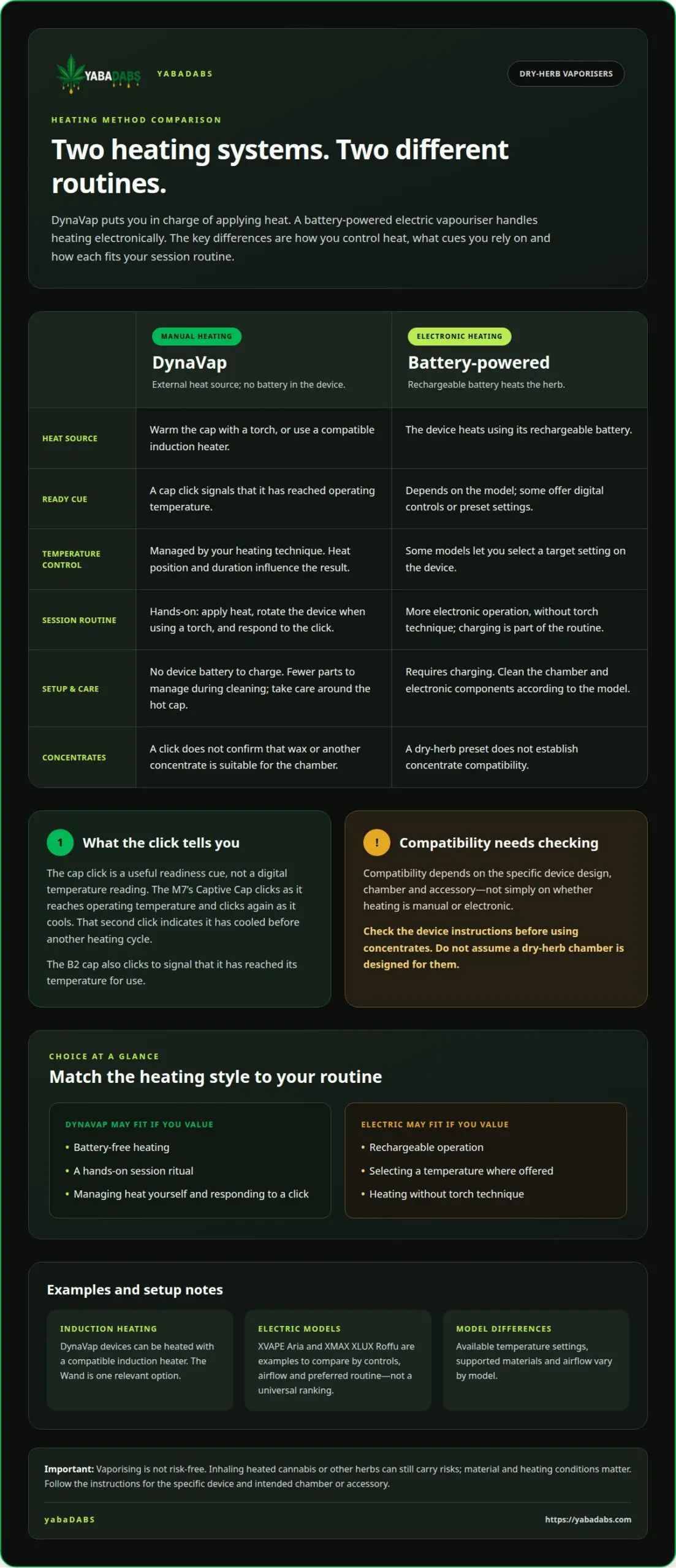
Compatibility depends on the vaporiser’s design, not simply on whether it heats manually or electronically. DynaVap’s temperature click tells you when its cap reaches operating temperature; it doesn’t confirm that wax or another concentrate is suitable for the chamber. Check the instructions for the specific device and any concentrate accessory before loading it. Don’t assume a dry-herb chamber is also designed for concentrates.
With a DynaVap, heating is hands-on. Use a torch to warm the cap, rotating the device as you heat it, and listen for the click that signals readiness. The M7’s Captive Cap clicks when it reaches operating temperature and clicks again as it cools. That second click matters: it indicates the device has cooled before you begin another heating cycle. The B2 cap also clicks to signal that it has reached its temperature for use.
The click is a useful cue, not a digital temperature reading. A torch gives you direct control over where and how you apply heat, while timing and technique influence the result. DynaVap devices can also be heated with a compatible induction heater. For a setup using that method, The Wand induction heater is a relevant option.
Battery-powered electric vapourisers handle heating differently. Some provide digital temperature controls and preset settings, allowing you to select a target rather than judge heat by a click. The available settings and materials supported depend on the model. A preset for dry herb, for example, doesn’t establish that the device is designed for wax. Follow the model’s instructions and use only the chamber or accessory intended for that material.
| Option | Heating cue | Temperature control | Concentrate use |
|---|---|---|---|
| DynaVap | Torch or induction heater; cap click | Manual heating technique | Check device instructions and accessory compatibility |
| Battery-powered electric vapouriser | Battery-powered heating | Digital controls or presets, where offered | Check model and chamber support |
Choose manual control if you’re comfortable managing the heat source and responding to the click. Choose digital controls if selecting a temperature on the device better suits your routine. In either case, a temperature cue is not proof of concentrate compatibility.
Vaporising isn’t risk-free. Avoiding combustion may reduce exposure to some products of burning, but inhaling heated cannabis or other herbs can still carry risks. The material and heating conditions matter, and a device doesn’t make inhalation harmless.
How to Choose a Dry Herb Vape?
Start by deciding how you want heating to work: by hand or through rechargeable electronics. That choice affects your routine, temperature control and travel setup.
DynaVap Flame Heating
A DynaVap dry-herb vaporiser has no battery. Heat its cap with a torch lighter or a compatible induction heater, then use the click as the ready cue. The M7 can be heated externally, so you manage the heat rather than selecting a temperature on a screen. With a torch, rotate the device as you warm the cap and follow its instructions. The method rewards steady technique; it also keeps charging out of the session routine.
Manual heating is less precise than selecting a digital setting, but it gives you direct influence over the process. The position and duration of heating affect extraction. Airflow also depends on the device and how you draw, so use measured draws rather than expecting every vaporiser to feel the same. An induction heater replaces the flame while keeping the device itself battery-free.
Battery-Powered Electronic Heating
An electric dry-herb vaporiser uses a rechargeable battery to heat the herb. Some models offer temperature controls, letting you select a setting without using a torch or induction heater. This can make operation more straightforward, though you’ll need to charge the device and work within its available settings. Heating style and airflow vary by model, shaping the draw and flavour experience.
There isn’t one best battery-powered portable dry-herb vaporiser for everyone in the UK in 2026. The XVAPE Aria and XMAX XLUX Roffu are examples to compare by controls, airflow and the routine you prefer, rather than by a universal ranking.
A DynaVap has fewer parts to manage during cleaning, but take care around the hot cap and manual heating. An electric vape avoids torch technique, while its chamber and electronic components require model-specific cleaning.
A dry-herb vaporiser is equipment. The legality of buying, possessing or using it depends on the material and applicable UK law. The device itself doesn’t make a substance lawful.
There isn’t one flight rule for every UK journey. Whether you can carry a vaporiser depends on airline battery rules and destination restrictions; a torch lighter has separate carriage considerations.
UK prices vary by model, features and included accessories, so there’s no single price for DynaVap or battery-powered portable vapes. A DynaVap works by heating its cap externally until it clicks; use a torch lighter or compatible induction heater as directed for that device.
Choose DynaVap if you want battery-free heating and are happy to manage the technique. Choose an electric model if rechargeable operation and selectable temperature settings better suit your day. To explore options by style, browse dry-herb vaporiser choices.
Choosing a vape for different user preferences
Your preferred routine matters as much as the heating method. A dry-herb vaporiser should suit how you handle preparation, session control and portability. Consider what you want to keep simple: charging, managing heat, choosing settings or carrying the device.
If you enjoy a hands-on ritual, DynaVap’s manual process may feel rewarding. You prepare the device, apply heat and respond to its click. That gives you a physical role in each session, rather than relying on a screen. DynaVap devices can offer a ritual similar to smoking, which may appeal if you prefer an involved routine.
For a more set-and-go approach, an electric model may suit you better. Battery-powered dry herb vapourisers heat the material electronically, and some offer precise temperature settings. You choose a setting on the device instead of judging heat by technique. The trade-off is another routine to manage: charging the battery before use.
Heating method can also shape the feel of a session. DynaVap uses conduction heating, with the cap warmed externally. Electric dry-herb devices may use convection or hybrid heating, depending on the model. These methods affect how heat reaches the material, so consider whether you prefer direct manual control or device-managed heating.
Which portable dry herb vapes are most discreet and travel-friendly? DynaVap devices are small and don’t need charging, but you still need a torch or compatible induction heater. XVAPE Aria and XMAX XLUX Roffu are portable-vape examples to compare by form and operation, rather than assume one is discreetest for everyone.
Travel convenience also depends on what you’re willing to carry. A DynaVap setup needs a separate heat source; an electric portable vape needs its battery charged. Before a journey, consider the device, its accessories and intended use together. A small vaporiser may be easy to pack, but the complete setup determines how convenient it feels.
Session habits offer another useful test. If you like adjusting your technique from one draw to the next, manual heating offers that involvement. If you prefer selecting a temperature and letting the device manage heating, an electronic model may better match your pace. Neither preference guarantees a particular flavour; airflow and device design also shape the draw.
Use these prompts to narrow your choice:
- Prefer a ritual? Consider whether manual heating suits your routine.
- Prefer settings? Look for an electric model with temperature controls.
- Travel often? Compare the complete setup, including a torch or charging needs.
- Value compactness? Compare the device itself and what must remain with it.
The best fit is the one that matches your habits. For example, someone who dislikes charging may lean towards DynaVap, while someone who values selectable settings may prefer an electric portable vape.
Device modularity and customization
Customisation can mean changing chamber size, connecting a water piece or selecting heat settings. DynaVap offers physical adjustments, while electric vaporizers may let you change temperature electronically. In practice, one adapts through compatible components and technique; the other uses controls built into the device.
On the DynaVap M7, the Adjust-a-Bowl configuration reduces the effective chamber size by roughly half. That gives you a smaller-load option without changing the vaporizer. It’s useful if you want to adjust the amount of dry herb per session. The change is mechanical, not a digital setting, and the chamber remains part of the same device.
Water-piece compatibility adds another kind of flexibility. The DynaVap M7 works with 10 mm water pieces, and the DynaVap B2 is also compatible with 10 mm waterpieces. That shared connection size can help guide accessory choice. Match the connection carefully; a water piece with a different size won’t provide the same direct fit.
Electric models offer a different kind of customisation. A device with digital temperature controls lets you select a heat setting, while its chamber and airflow remain model-specific. Convection or hybrid heating may shape how the material is heated, but don’t assume you can change the heating style through a menu. Settings adjust only what that particular vaporizer supports.
These differences matter for durability, too. DynaVap devices have no electronics, while battery-powered models rely on electrical components. Electric batteries can degrade after a few hundred charge cycles, and electronic components may fail over time. That doesn’t make every manual device more durable; it means the two designs have different components and potential wear points.
Think about what you actually want to customise before choosing:
- Load size: the M7 Adjust-a-Bowl reduces effective chamber size by roughly half.
- Water-piece connection: the M7 and B2 both fit 10 mm water pieces.
- Temperature: electric models may offer digital settings, depending on the device.
- Heating design: convection or hybrid heating is a model feature, not automatically an adjustable setting.
A modular setup can suit someone who likes adapting the physical arrangement. For example, the M7’s chamber adjustment changes the load size, while its 10 mm connection allows a compatible water piece. An electric vaporizer may suit someone whose main preference is selecting temperature settings, rather than changing physical components.
Choose based on the adjustment you’ll use most. If chamber size and a 10 mm water-piece connection matter, DynaVap offers clear examples. If selecting heat settings matters more, compare electric devices by the controls and heating design each model provides.
How battery-powered electric vapes work
A battery-powered vaporiser turns stored electrical energy into heat inside its chamber. You load dry herb, switch on the device and select a setting if available. The heater warms the material, then airflow carries the vapour through the mouthpiece. This internal heating replaces the external heat source used by a manual device.
Heating design affects how a session feels. In a conduction vaporiser, a heated chamber surface transfers heat directly to the herb. In a convection design, warm air passes through the material. Hybrid devices combine both approaches. These distinctions affect how heat reaches the load, while airflow, temperature and draw also influence extraction.
Temperature controls let you choose a target rather than judge heat by hand. Lower and higher settings can produce different results from the same material. Start with the manufacturer’s guidance, then adjust gradually if the vaporiser allows it. Changing one setting at a time makes it easier to notice how heat affects flavour and vapour.
Battery runtime between charges depends on the model, battery capacity, selected temperature and session length. Charging time depends on the device’s battery and charging system. Repeated sessions at a higher setting may use charge differently from shorter sessions at a lower setting. Follow the device instructions for charging and storage.
During use, keep airflow steady and avoid packing the chamber so tightly that air can’t pass through the herb. After a session, let the device cool before emptying the chamber. A clear airflow path supports the intended draw; residue on screens or inside the chamber can affect airflow.
Cleaning helps keep an electric vaporiser working as intended. Follow the model’s cleaning instructions, especially around the heater and electrical components. Never soak a battery or electronic base. Removable chambers or screens may have separate cleaning steps from the main unit, so follow the guidance for each part. Switch the device off and let it cool before cleaning.
For a straightforward routine, use this sequence:
- Charge the device as its instructions direct.
- Load the chamber without blocking airflow.
- Select a suitable temperature setting, where available.
- Draw steadily, then let the device cool before cleaning.
That process suits people who value electronic temperature selection and a repeatable setup. To compare portable vaporiser options, consider how each model’s heating, controls and chamber fit your session habits.
YabaDABS: DynaVap vaporizers
yabaDABS offers DynaVap vaporizers alongside Hamilton Devices, XVAPE and XMAX options, so you can compare manual and battery-powered styles in one place. Explore these options when you’ve decided which operation, controls and session routine suit you, but want to narrow down the device type.
If manual heating is your preference, explore the DynaVap range. If you’d rather use a portable electric vape, consider XVAPE and XMAX options. Hamilton Devices offers another choice in the wider vaporizer selection. Focus on the features that matter to your routine, rather than assuming one style suits everyone.
For a clearer comparison, contact yabaDABS and share what you’re looking for in a vaporizer.
Make your next choice with confidence
Choosing between DynaVap and battery-powered portable vapes is really about the routine you want around your device. Consider the role of temperature control, portability and hands-on use, then narrow down your options according to those priorities. Your ideal setup should suit the way you plan to use it, not simply look appealing on a shelf.
yabaDABS offers DynaVap vaporizers and Hamilton Devices vaporizers, alongside the Focus V Carta 2. These give you different directions to explore as you settle on a device style. The right next step is a conversation focused on what matters to you, whether that’s manual operation or a battery-powered option.
Contact yabaDABS for vape advice and take your time choosing a setup that feels right for you.
Frequently Asked Questions
What is DynaVap?
DynaVap makes manual dry-herb vaporizers, including models such as the M7 and B2. Rather than relying on a built-in battery, the device is heated externally and its cap provides a cue during use. This format suits people who want a compact device and don’t mind handling the heating process. Before choosing a model, consider chamber size, compatible accessories and the manufacturer’s instructions.
Digging Into Flame-Powered Devices: Why Go Battery-Free?
A battery-free device can suit someone who doesn’t want charging to be part of their routine. With a DynaVap, the heat source is separate, so the device itself doesn’t depend on a rechargeable battery. You’ll still need to carry and use a suitable torch or induction heater. Consider the complete setup, including the heat source, rather than judging convenience by the vaporizer alone.
Flame-Powered vs Battery-Powered Dry Herb Vaporizers: What Sets Them Apart?
The main difference is how the device heats its chamber and how you control that process. A DynaVap relies on external heat and user technique; an electric vaporizer uses a battery, with controls that depend on its model. For example, the XMAX V3 Pro has session and on-demand modes. Compare operating style, charging needs and the controls you’ll actually use.
The Bottom Line: Flame-Powered vs Battery-Powered, What’s the Call?
Choose a flame-powered device if you value battery-free operation and are comfortable managing an external heat source. Choose an electric vaporizer if battery-powered heating and built-in controls better suit your routine. When comparing DynaVap with battery-powered portable vapes, consider where you’ll use the device, what you want to carry and how involved you want each session to be.
What is a Portable Vaporizer?
A portable vaporizer is a compact device designed to be carried between places, rather than used only as a fixed desktop unit. Portable models work in different ways: a DynaVap uses external heating, while an electric model uses a rechargeable battery. “Portable” describes the format, not the material it supports. Check each model’s instructions for intended use and compatible accessories.
How does a DynaVap compare with battery-powered portable dry herb vaporizers?
A DynaVap keeps the device itself battery-free, while a battery-powered portable vaporizer needs charging for its electronic heater. The XMAX V3 Pro, for instance, offers session and on-demand modes, giving users different ways to operate it. DynaVap instead centres the experience on manual heating. Your preference for direct involvement or device-managed operation is a practical way to narrow the choice.
How do vapour quality, heating time and temperature control compare?
Neither heating style guarantees better vapour quality. The result depends on the device, material, airflow and how you handle the session. A DynaVap uses a click as a heating cue, while electric models may let you select temperature settings. Heating time depends on the device’s design and instructions. Compare the controls and draw that suit your routine, rather than expecting one universal result.
What are the best battery-powered portable dry herb vapes in the UK in 2026?
There isn’t one best model for everyone. The XVAPE Aria and XMAX XLUX Roffu are examples to compare by controls, airflow and the routine you prefer.
Disclaimer
Articles on yabaDABS are for general information only and do not constitute medical or legal advice. Products are intended for adults aged 18 and over and lawful use only. Follow the manufacturer’s instructions and check the laws that apply where you live. Consult a qualified healthcare professional before using CBD or other cannabinoid products, particularly if you take medication. Prices, specifications and availability may change; check the product listing before ordering.