
If you’re searching for “DynaVap, Battery-Less”, the key distinction is that battery-free describes how a device gets its heat, not how that heat reaches dry herb. A DynaVap vapouriser uses an external heat source, but that alone does not make it purely a conduction or convection device. Product descriptions can use these terms side by side, so it helps to separate the power source from the heating method.
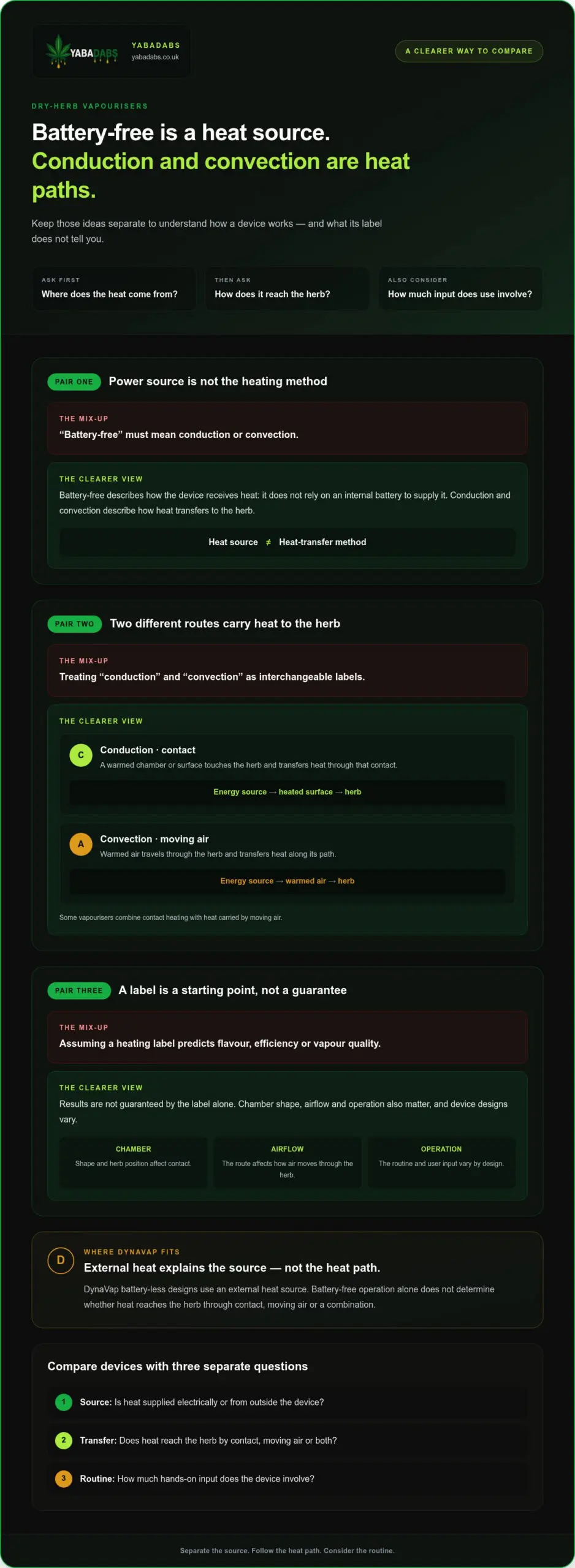
Conduction and convection describe how heat transfers to the herb. Battery-free means the device does not rely on an internal battery to supply heat. Neither term alone tells you which vapouriser will suit your preferences, but together they can help you compare how a device works and what using it involves.
This guide explains how conduction and convection work, outlines practical trade-offs, and shows where DynaVap fits. As you compare options, consider the heat source, how heat reaches the herb, and how much hands-on input the routine involves.
Key Takeaways
- Conduction transfers heat through contact with a warmed surface; convection transfers heat through moving warm air. Some devices combine both.
- A vapouriser’s power source and heating method are separate features, so compare them separately.
- Consider how much hands-on input each device requires and whether its routine suits you.
- Use portability, preferred controls and comfort with external heat to narrow your options.
- DynaVap battery-less designs use external heat, but battery-free operation is not itself a heating method.
Conduction vs convection vapourisers: what do the terms mean?
Conduction transfers heat through direct contact with a warmed surface. Convection transfers heat as warmed air moves through the herb. Some vapourisers use both, so these labels describe how heat reaches the material, rather than always defining a device as one type or the other.
The heat source supplies energy; the heat-transfer method describes how that energy reaches the herb. A device may use an electrical element or an external heat source. Neither tells you by itself whether the chamber relies on contact, airflow or a combination. Battery-free describes the power arrangement, not a third heating category. That distinction helps explain DynaVap battery-less designs: they use external heat, but that does not make “battery-free” a synonym for conduction or convection.
For a broad overview of the approaches, see Vaporizer (cannabis) heating methods. Device details vary, so focus on the route heat takes rather than relying on a label alone.
How does conduction heat dry herb?
In a conduction design, a warmed chamber or other heated surface touches the herb and transfers heat into it. Material against the chamber wall receives heat through that contact. The position of the herb and how evenly it is loaded can affect how it meets the warm surface. This describes the general process, not a guaranteed result for every device.
How does convection heat dry herb?
In a convection design, warmed air travels through the herb and transfers heat along its path, rather than relying only on contact with a hot chamber surface. Airflow is part of the process: the route through the material and the way you draw can influence heat transfer. Devices differ in how they warm and direct air, so there is no single draw technique or airflow pattern for every convection vapouriser.
These terms are useful starting points, not performance guarantees. A conduction label does not automatically predict flavour, efficiency or vapour quality, and convection does not guarantee a particular result either. Chamber shape, airflow and operation all matter. Some designs combine contact heating with moving warm air.
When comparing devices, separate three questions: where the heat comes from, how it reaches the herb, and how much input you provide. A battery-powered vapouriser can use conduction, convection or both. An externally heated device can also transfer heat through contact and airflow. This makes product descriptions easier to interpret than a simple battery-free versus powered comparison.
How conduction and convection vapourisers work in practice
To understand what happens inside a vapouriser, follow the heat from its source to the herb. Electricity may power a heating element, or heat may be applied from outside the device. Those describe how energy is supplied. Conduction and convection describe how that energy travels into the material. Keeping these steps separate makes product descriptions easier to assess.
What happens inside a conduction vapouriser?
In a conduction-led design, an energy source warms a chamber or contact surface. The herb receives heat where it touches that surface, and heat then spreads through the material. The chamber’s shape and the way the herb is loaded affect where contact occurs. A loose or uneven fill may sit differently from a more even layer, changing how it meets the warmed surface.
Heat path: energy source → heated chamber or surface → herb.
What happens inside a convection vapouriser?
In a convection-led design, the energy source warms air, which moves through the chamber and transfers heat to the herb. The air’s route matters: chamber openings, airflow design and the arrangement of the material can all affect where warmed air travels. Drawing helps move air in some devices, but the technique depends on the design.
Heat path: energy source → warmed air → herb.
These paths are useful models, not a full description of every device. Some designs combine contact with a heated surface and heat carried by moving air. For instance, a chamber wall may warm while air passing through the chamber also carries heat to the material. The balance depends on the device’s construction, so a broad label may not describe every detail of its operation.
Loading and airflow add another practical consideration. With contact heating, the position and amount of herb affect how it meets the chamber surface. With airflow heating, the arrangement can affect how air passes through the material. Follow the device’s instructions for loading and operation, since there is no single technique that applies to every vapouriser.
Power source is a separate consideration. An electrically powered device uses electricity to generate heat; an externally heated, battery-less design receives heat from outside the device. This distinction does not tell you whether heat reaches the herb through contact, moving air or both. DynaVap vapourisers are an example of external heating, but battery-free operation alone does not place every model into one heat-transfer category.
For a closer look at the range, explore DynaVap vapourisers and other portable devices. As you compare options, look at the chamber, airflow and user input as well as the power source. Those details give a clearer picture of the heating process than “powered” or “battery-less” on its own.
Conduction vs convection vapourisers: which trade-offs matter?
Heating labels offer a starting point, not a guarantee of what a device will feel like to use. Conduction involves heat from contact with a warmed surface, while convection relies on warmed airflow. Device design, power source and the level of hands-on input all shape the routine.
Use this table as a guide to common tendencies, not as a set of rules for every model:
| Factor | Conduction | Convection | Battery-free design |
|---|---|---|---|
| Heat transfer | Heat reaches herb through contact with a warmed surface. | Warmed air carries heat through the herb. | Describes power dependence, not how heat reaches the herb. |
| Power source | May be electrically powered; the method itself doesn’t specify the source. | May be electrically powered; the method itself doesn’t specify the source. | Uses an external heat source rather than relying on an internal battery. |
| User input | Loading and contact with the chamber can matter. | Airflow and drawing can influence heat transfer. | Usually involves applying external heat and hands-on technique. |
| Learning curve | Can feel more direct, though operation varies by device. | May call for getting familiar with airflow and draw style. | Requires learning the device’s external-heating routine. |
Neither conduction nor convection is automatically best for everyone. The right fit depends on the routine, control and level of input you prefer. A powered device may suit you if you want its energy source built in. External heating may appeal if you are comfortable with a more hands-on approach. These are preferences to weigh, not promises about performance.
Is one heating method more consistent?
Not by category alone. Chamber shape, how the herb is loaded and how the device is operated can all affect how heat reaches the material. Contact matters in conduction designs; airflow matters in convection designs. Those principles explain possible differences but cannot predict identical results between models or sessions. Treat consistency as model-dependent rather than assuming it from a heating label.
Does battery-free mean a different kind of heating?
No. Battery-free describes power dependence, not heat-transfer mechanics. DynaVap vapourisers are an example of external heating, but that fact alone does not make them exclusively conduction or convection devices. Consider battery-less operation and the heating method separately, and use reliable information about the specific model for its classification.
If hands-on heating sounds like a better match for your routine, explore the DynaVap range alongside these comparison points. Focus on how you want to power and use a device, rather than choosing by one label alone.
How to choose a dry-herb vapouriser heating method
Start with the routine you want, not just the heating label. Decide whether you prefer a powered device or are comfortable applying heat externally. Then consider portability and how much hands-on input feels manageable. This decision path can help you narrow your options:
- Picture your usual setting. If you would rather not manage an external heat source, consider a powered option. If hands-on heating suits you, include battery-free designs in your comparison.
- Think about portability in practice. Consider what you are comfortable carrying and using, including the separate heat source required by a battery-free device.
- Choose your preferred level of input. Would you rather follow a powered routine, or learn to apply external heat and operate the device as instructed? Neither preference is better.
- Read the model instructions. Check how the specific device is operated. Do not assume every conduction, convection or battery-free model works the same way.
What should beginners prioritise?
Look for clear instructions, an understandable routine and a technique you feel comfortable practising. A powered device may suit you if you prefer not to handle external heat; someone else may prefer a more hands-on approach. The label alone cannot tell you which will feel easier. Consider how confident you feel with the operating steps.
When might a battery-free DynaVap appeal?
A DynaVap battery-less design may suit someone who prefers not to depend on an internal rechargeable battery. External heating is part of the routine, so follow the instructions for the specific model. “Battery-less” describes a power preference, not a guarantee of a particular experience. Compare model details rather than assuming every DynaVap vapouriser has identical specifications.
Make your comparison specific: note the power source, user input and instructions for each model. That is more useful than treating “conduction”, “convection” or “battery-free” as a complete answer. Explore vapourisers at yabaDABS and compare the routine with your preferences.
Where DynaVap fits in the conduction and convection comparison
DynaVap vapourisers are an example of battery-free, externally heated devices. This describes how heat is supplied, not how it transfers to dry herb. “DynaVap, Battery-Less” is best understood as a power-source description, not a synonym for conduction or convection. Those are separate parts of the comparison.
External heating makes the routine hands-on. How heat then reaches the herb depends on the device’s design. Contact with a heated surface and warmed air moving through the chamber are different heat-transfer processes, and a design may involve both. The battery-free label alone does not identify which applies.
What does battery-free operation change for the user?
It means the device does not rely on an internal rechargeable battery to supply heat. Instead, you use an external heat source as directed for that model. That extra step may suit someone who likes a hands-on routine, but it does not promise particular convenience, savings or performance. Consider whether the process fits the way you plan to use the vapouriser.
How should readers compare DynaVap models?
Compare each model’s details and instructions. Do not assume every DynaVap vapouriser shares the same specifications or operating steps. For example, you can assess the DynaVap BB3 GlassR vapouriser using its individual product information, then compare it with other models on the same practical points. The phrase “DynaVap, Battery-Less” does not replace model-specific guidance.
As you weigh up options, note the heat source, instructions for use and level of hands-on input. Then look for reliable, model-specific information about how heat reaches the herb. This keeps your comparison grounded in the device rather than assumptions based on a brand or broad category.
Keep the distinction in mind: DynaVap battery-free operation describes how heat is supplied, while conduction and convection describe heat transfer. Reading “DynaVap, Battery-Less” in that context can help you interpret product descriptions without assigning every model the same heating classification.
If external heating sounds like a routine you would enjoy, browse DynaVap vapourisers at yabaDABS and compare the available model information.
Make your next choice with confidence
Choosing a vapouriser also means choosing a routine. Before settling on a model, consider how much control you want, what you are comfortable handling and whether external heating suits you. Then compare the instructions and details for the specific device instead of letting a broad label make the decision for you.
If you are considering a DynaVap battery-less option, use that as a starting point. Explore the model information and think about how its operation fits your preferences. There is no need to rush towards one heating style; the useful comparison is the one that reflects how you want to use the device.
yabaDABS sells DynaVap vapourisers through its online store, with delivery across the UK. Explore DynaVap vapourisers at yabaDABS and compare the range to find a model whose routine suits you.
Frequently Asked Questions
What is the difference between conduction and convection in a vapouriser?
Conduction transfers heat through contact with a warmed surface, while convection transfers it through warmed air moving around or through the herb. Herb touching a heated chamber receives heat by contact; air passing through a chamber can carry heat to material along its route. A device may use both processes. These terms describe heat transfer, not whether a vapouriser is portable or battery-powered.
Is convection better than conduction for dry herb?
Neither method is automatically better for every person or device. The experience depends on the vapouriser’s design and how it fits your routine. When comparing models, look at their instructions, airflow and chamber design rather than choosing by the heating label alone. Consider what you prefer to control during use, too. A category name explains a principle, but it cannot promise a particular result.
Can a vapouriser use both conduction and convection?
Yes. A vapouriser can combine heat from contact with a warmed surface and heat carried by moving air. The balance depends on the device’s construction, so “hybrid” does not mean every model follows the same design. If a product description uses that label, look at what the model information says about its chamber and airflow. This is more useful than assuming the word guarantees a standard arrangement.
Does battery-free mean a vapouriser uses convection?
No. Battery-free does not identify how heat reaches the herb. A device without an internal battery could transfer heat through contact, warmed air or a combination, depending on its design. Keep the power source separate from the heating method when comparing descriptions. This distinction is useful when “battery-less” appears prominently in a product listing but heat-transfer details are described elsewhere.
How does a DynaVap vapouriser work without a battery?
A DynaVap vapouriser receives heat externally rather than relying on an internal rechargeable battery to supply it. The user applies heat as part of operating the device, following the instructions for that model. This makes DynaVap an example of battery-free use, but it does not establish a single heat-transfer classification for every model. Use the individual product information to understand its design.
What heat source can be used with a DynaVap vapouriser?
A torch or an induction heater can be used as an external heat source for DynaVap devices. The suitable method and operating steps may depend on the model, so follow its instructions rather than assuming all models are used identically. External heat is part of the routine to consider when deciding whether this style of vapouriser suits you.
Are conduction and convection the only dry-herb vapouriser heating methods?
They are the two main heat-transfer approaches commonly used to explain how dry herb is heated, and some designs combine them. “Hybrid” describes that combination, not a separate power source. Other terms in product descriptions may refer to the heat source or device controls rather than a new heat-transfer process. If a label is unfamiliar, look for an explanation of how heat reaches the herb.
What should a beginner compare before choosing a vapouriser?
Compare the device’s instructions, power source, operating routine and level of user input. Ask yourself whether you would rather use a powered device or are comfortable applying external heat. Read the model’s guidance on loading and operation, then consider whether the routine feels manageable. A clear match between the instructions and your preferences is more useful than choosing by heating category alone.
Disclaimer
Articles on yabaDABS are for general information only and do not constitute medical or legal advice. Products are intended for adults aged 18 and over and lawful use only. Follow the manufacturer’s instructions and check the laws that apply where you live. Consult a qualified healthcare professional before using CBD or other cannabinoid products, particularly if you take medication. Prices, specifications and availability may change; check the product listing before ordering.